pristine

The Technology Hype Lifecycle: Google Glass Edition

This post originally featured on Forbes.

Recent announcements from Google about the future of Glass naturally ignited an explosion of commentary in the tech media. For those of us in the Glass at Work world, the news that Glass has “graduated” from Google[x] into a true business unit headed by Tony Fadell is very promising. Yet many outlets’ coverage focused on the end of the Glass Explorer program for consumers, characterizing it as the final death knell for the technology.

So why the disconnect?

Historically, Glass has fallen victim to the technology hype lifecycle, and has done so more strongly than most technologies.

The Technology Hype Lifecycle

There’s a famous graph you’ve probably seen before on the Internet that charts the lifecycle of hype for new technologies.

But in a number of ways, this graph isn’t quite right – specifically, the plateau of productivity isn’t illustrated correctly. Technologies plateau far above the peak of inflated expectations.

Consider Mobile Computing

In the late 1990s and early 2000s, Microsoft recognized the potential of mobile devices, so they built Windows Mobile and worked with OEMs to deliver Windows Mobile phones. They were way too early and made some fundamentally poor design decisions. They dreamed big, but failed to deliver on most of them. By 2004, BlackBerry was emerging with phones that could support basic business communications, contacts and calendar functions. Mobile computing was exiting the trough of disillusionment. Google saw this and bought Android in 2005. Rumors suggest Apple started development of the iPhone in late 2004/early 2005. They saw it too.

What no one foresaw was not only how fast the curve would ramp up, but the magnitude of the peak. Even in 2009, no one could have imagined Uber or Tinder or Snapchat, let alone 2007. Even today, we still do not know where the curve will plateau. How could Microsoft, or anyone else for that matter, have seen the potential of mobile computing in 1999 when they committed to building the (failed) future of mobile computing?

The mobile computing hype cycle graph actually looks something more like this.

Who knows which of today’s Series A and Series B stage startups are the next Uber? Kevin Spain from Emergence Capital has recently been evangelizing that today’s enterprise mobility market resembles that of the cloud in 2004. If that’s the case (and given mobile’s incredible penetration today), there is only one inevitable conclusion: mobile is eating everything.

So What About Glass?

Right now, in early 2015, Glass seems to be deep in the trough of disillusionment. The media has been hammering Glass lately, declaring its demise and failure, and before today’s announcement, Google itself was very quiet about Glass’s future. For the record, Glass is not just alive and well, but thriving in professional and enterprise use cases.

But what’s much more important isn’t Glass’s near-miss with death, but its tremendous potential. Glass is today where mobile computing was in 2000: dreams seemingly shattered by early setbacks.

The Glass curve will look a lot more like the mobile curve than the famous generic curve. We are seeing tremendous growth as enterprises adopt Glass to solve painful economic problems that were previously unsolvable.

The Glass growth curve will not mirror the mobile growth curve identically. Glass will peak at a lower point on the hype cycle graph than smartphones did. Smart glasses simply don’t have the upside potential on a per-person basis that smartphones do. Glass competes with smartphones; smartphones compete with laptops. The marginal improvement from always-on-you smartphones to hands-free Glass is material, but not as large as the jump from sitting-only laptops to always-on-you smartphones. Moreover, the best use cases for Glass are for desk-less, hands-on workers; these workers typically earn substantially less than their white collar, desk-bound counterparts. Smartphones amplify the productivity of expensive workers; glasses multiply the productivity of less expensive workers.

Having said that, Glass is still nascent today. We are at the tip of the iceberg. There is tremendous potential to be had in hardware, software and services. Over the next few years, we will see tremendous innovation from startups and giants. Hardware experiences are going to diverge. Software developers will experiment and pioneer new user-interaction models. Cloud services will evolve and take on an increasing percentage of computing. We know nothing, which means we can still do anything.
The Virtuous Cycle of Sacrifice in Startups

I ask people to sacrifice dozens of times a day. I ask candidates and my team to sacrifice employment at bigger companies that pay more and expect less. I ask our investors to put the capital they went to such great lengths to raise behind us. I ask prospects to believe that our insanity can solve pressing business problems. I ask partners to expend their precious resources on us.

I ask literally everyone around me to give up something substantial. I am always asking. Thus I am always taking.

Except that I'm not.

I ask our stakeholders to give...to our stakeholders. Everyone is sacrificing for everyone:

Our employees sacrifice for our investors, customers, and partners. They bust their asses day in and day out. Our engineers are working into the evenings regularly to deliver for our customers. Our marketing team is rapidly accelerating our public profile and our lead generation machine so that our engineers' code can make a dent in the world. Our sales team is creating value for customers. Our client success team is moving mountains to fulfill our promises. Everyone at Pristine is doing everything they can for our customers, investors and partners.

Our investors have gone out on a limb for our employees, and in turn, our customers and partners. And we put them to work: we work with them nearly daily to find and close candidates, customers, and partners. They know how hard it is to create a new market, and they are betting their time and precious capital on our ability to succeed. They are all in for everyone else.

Our customers are placing bets on us. They're betting that we aren't full of it. They're betting that we aren't a security liability. They're betting that we won't disrupt their mission critical business operations. They're betting that we don't piss away their capital into the massive abyss of failed startups. Executive sponsors within our customer organizations are risking their political capital with us to build our mutual vision. Our customers are sacrificing for our employees, investors, and in turn partners.

Our partners are betting on us too. They shouldn't waste their time on losers. We have to prove to them that we deliver value: relationships, revenue, growth, marketing, and more. They're offering their time and effort for our customers, investors, and employees. They expect that we reciprocate.

Many people love the energy and vibe of a startup. Although it's easy to attribute the startup mentality of boundless optimism to naivety about the challenges ahead, there is a deeper source of connection. We all know that we are sacrificing for one another. It fosters a deeper bond between all of us. We aren't here because we just need to feed ourselves; we're here because we believe in a shared mission.

We are all sacrificing for one another. That is the virtuous cycle of sacrifice in startups.

The Pristine Story: Springing Ahead

Since the last episode of the Pristine Story, we've been busy as springtime bees!

Since announcing our launch at Brown University, we've gone live at three additional hospitals, with several more coming in May. We're holding back on PR for a bit, but will have some big announcements in the coming weeks, so keep an eye out for those.

We're not just busy at home, though...

HIMSS INNOVATION SUMMIT

Dr. Paul Porter (from Brown University) and Kyle will be presenting at the National Healthcare Innovation Summit in Boston.

They'll discuss Brown's experience using Glass for telemedicine in the ER, and present data on how Pristine's solutions dramatically improve efficiency in the care delivery system.

ATA ANNUAL MEETING 2014


If you're headed to the American Telemedicine Association Annual Meeting in Baltimore, come visit us at Booth #1814. We'll be the ones in clever T-shirts and Google Glass.

In fact, we're giving away a Google Glass unit to one lucky ATA attendee, so make sure to stop by our booth and enter our raffle!

Engineering Update
 
Our engineers led the most recent meeting of the Austin Google Developer Group (GDG) diving into the innards of WebRTC on Android.

Keep an eye on The Looking Glass (our engineering blog) over the next few days for more on how Pristine uses WebRTC, our slides from the GDG meeting, and more.
 
Finally, while it may be busy in the land of Pristine, we still find time to commit our thoughts to prose. To wit, our recent blog post (penned by Kyle) that examines the difficulty in reducing the cost of care.

And if you need more material to for your week's reading. There's plenty more analysis, commentary, and forward-looking thought on our blog. Enjoy!

That's it for this installment of the Pristine Story, stay tuned for more!

Until next time,

Why Telehealth?

Telehealth, aka telemedicine, is one of the most important trends shaping the future of healthcare. It is one of the most effective and direct ways to achieve the triple aim of cost, quality, and access.

This blog post will attempt to explain the underlying problems in the healthcare delivery system that telehealth addresses. As a result of solving these problems, telehealth creates value along all dimensions of the triple aim.

Healthcare delivery is fragmented across medical discipline, location, and time. In a given location, it can be difficult to get the right specialist to a patient in need. Specialists are busy and have full schedules in their clinics everyday. Specialists don't want to leave their clinics and patients don't want to go to the specialists' clinics. The cost of travel - time, cost, and distance - is significant for all parties. Neither party wants to travel to see the other.

Within a given location, there is almost always significant supply and demand imbalances for healthcare services. Telemedicine addresses the supply and demand problem by making location irrelevant. In a world in which telehealth is the norm instead of the exception, a patient in need should be able to access a qualified specialist from a much larger pool than in the analog era of healthcare delivery. Solving the access problem by increasing supply in every location also addresses cost and quality problems. Telemedicine addresses cost problems by forcing providers to compete to provide the best care at the lowest price. Telemedicine addresses quality problems by reducing the time to care, which can meaningfully impact outcomes.

At Pristine, we're proud to pioneer a new avenue of telehealth. Our telehealth solutions are by far the lightest-weight and easiest to use in both physical and virtual terms. Are clients don't need any physical infrastructure or local servers at their local sites. In fact, our clients don't even need to install software on their Macs and PCs. Everything runs natively in the web browser in beautiful HD.

Our clients - UC Irvine, Brown, and soon to be several more - are using our solutions every day to address the supply-demand challenge of healthcare delivery, and as a result, are working towards the triple aim.

Onwards and upwards!

The Pristine Story: Planting Seeds For Growth

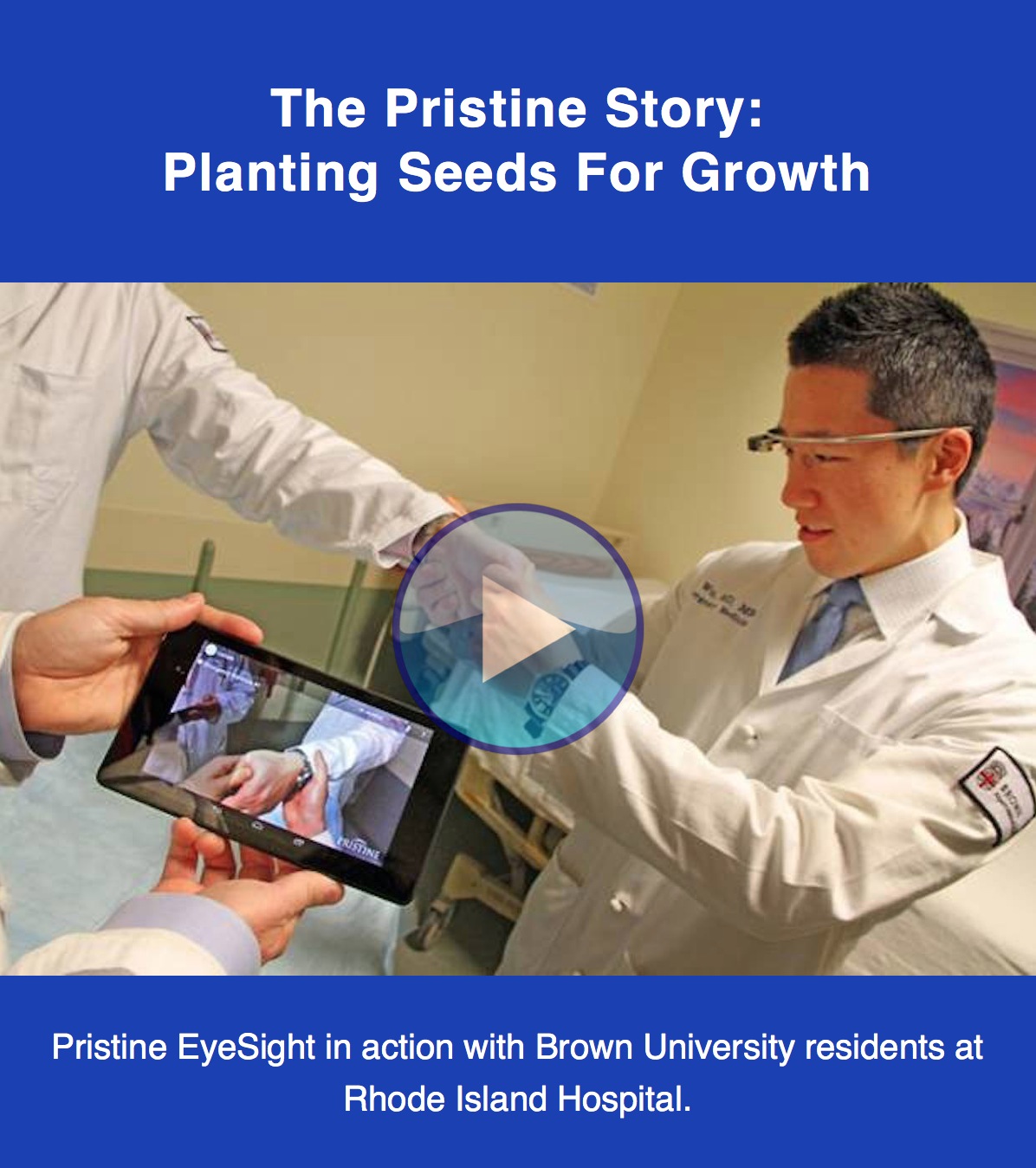
50% of patient wait times in the ER can be attributed to waiting for specialists to arrive. The ER staff at Rhode Island Hospital (affiliated with Brown University) are using EyeSight to beam consulting physicians into the ER when consulting physicians would otherwise be unable to physically come in and see patients. We'd like to highlight the clinicians at Rhode Island Hospital, who recently went live with Pristine EyeSight in the ER. We'd like to especially thank Dr. Paul Porter, Dr. Peter Chai, and Dr. Roger Wu for driving the project. You can see videos EyeSight live by clicking on the image above.

Over the past couple of months, we've been working tirelessly to ensure smooth EyeSight rollouts. We've been building out robust test suites, automating deployment mechanisms, and building out new layers of security and authentication. You can take a peek inside by checking out the Pristine engineering blog.

We continue to grow the team. We recently brought aboard 2 new salesmen - Jason Sorrells, and Justin Cannon - both of whom have years of experience selling medical devices and health IT solutions. They're operating regionally throughout the US and helping us reach environments that we would have otherwise been unable to reach.

And as always, we continue to blog away. This month, we'd like to highlight a post from our Client Success Manager, Brett Hogan, who outlined some of the challenges that hospitals and physicians are facing as they try to adopt Glass out-of-the-box.