A Glimpse of Amazon's Genuis

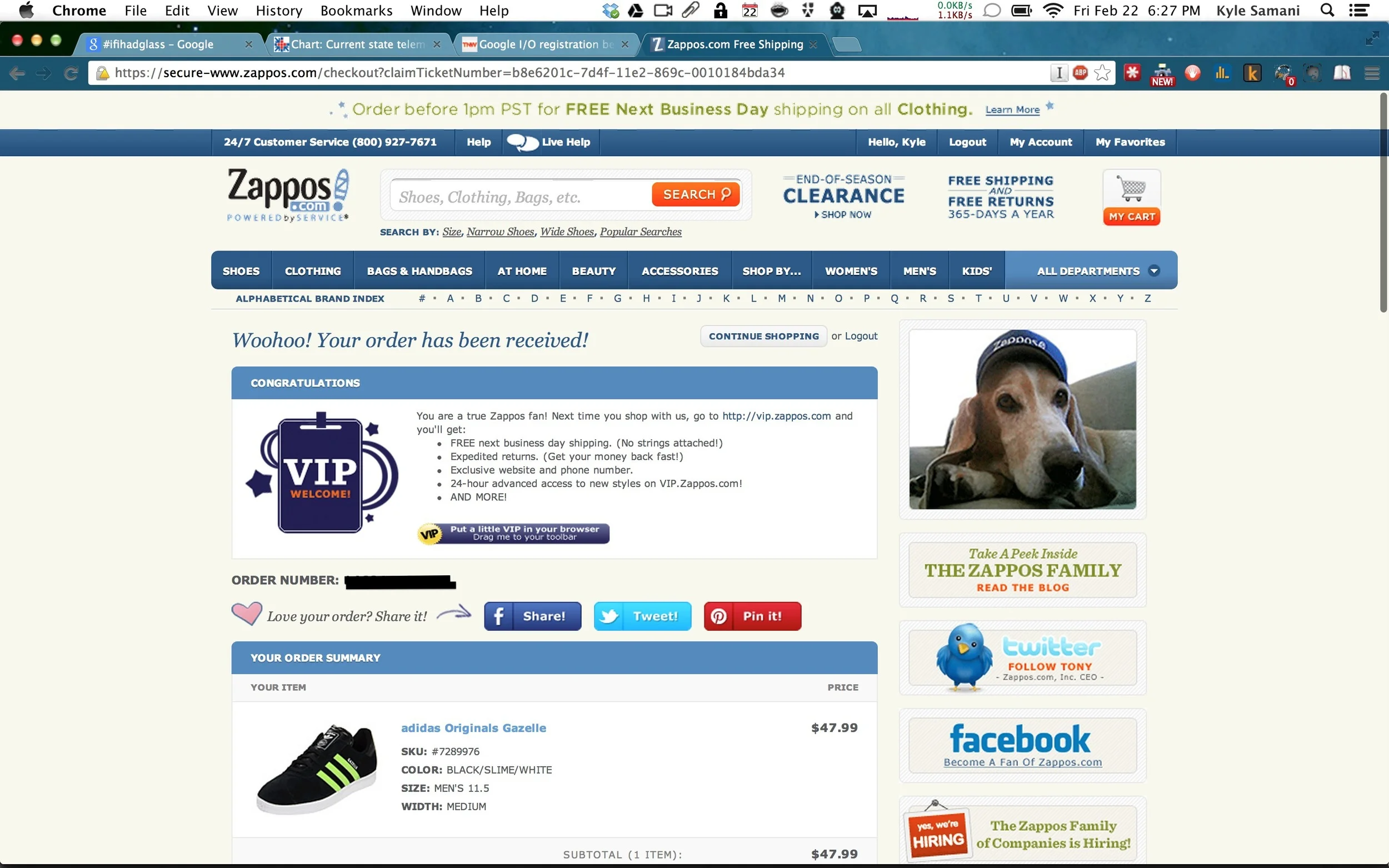
I just bought my 3rd pair of shoes from Zappos (Zappos is owned by Amazon), and I was treated with this:​

Screen Shot 2013-02-22 at 6.27.11 PM.JPG

This is genius. Zappos knows that I'm well on my way to becoming a regular customer. At this point, they want me to fall in love with them. Once I fall in love, it will be hard to fall out.

Everything is done right: The big VIP badge, free next day shipping on my next order, sharing options, and even early access to new styles at vip.zappos.com tha makes me feel special.

​I've been hooked on Amazon for years. I rarely purchase something from retail other than food; everything goes through Amazon. The convenience, the Prime shipping, and the sense of security I have shopping with them is extremely valuable. Chances are, I'll be an Amazon customer until the day I die.

​What a beautiful strategy. As Warren Buffet said, "In business, I look for economic castles protected by unbreachable moats." Amazon's moat: the lowest possible prices made possible by enormous economies of scale and remarkably low overhead, and extreme customer loyalty achieved by offering world-class customer service.

Tasteless Advertising

Time Warner Cable (TWC) has been running a series of ads on Hulu promoting apps that allow cable subscribers to stream cable TV via the Internet on non-PC devices like iPads. The commercial ends with TWC's new tagline, "Enjoy Better."

This is by far the most tasteless corporate tag line I've ever seen, heard, or smelled. It means absolutely nothing. TWC's advertising team simply chose two adjectives with positive connotations and stuck them together. In an effort to be pleasant and appeal to everyone, they have appealed to no one. This slogan is horribly egregious in its lack of creativity and corporate sincerity. It tells the world that TWC has no taste, no creativity, no inspiration, and that they're not even willing to try. They settled for generic shit advertising.

I recently finished reading Insanely Simple - The Obsession that Drives Apple's Success by Ken Segall. Ken has worked with the CMOs at most of the major technology firms including Apple and Intel. It's amazing to here his anecdotes about the marketing processes at each company. They vary so drastically. Apple's marketing team is driven by a sense for style and genuine belief in the products they're marketing. Once the marketing team finalizes an ad, it goes out to the world. Intel's commercials go through an enormously complicated approval process, where half a dozen parties each have veto power (legal, C-Suite, style-team, etc). By the time all six parties have exercised veto power, the commercial is reduced to something generic and uninspiring.

I can only imagine how similar TWC's marketing approval process is to Intel's. Just imagine how much people had their hands in the process of settling on the phrase "Enjoy Better."

Hey TWC, you know what I would enjoy better? Sincerity, thought,  and drive.

The Battle for the Mom and Pop Shops

I never really cared for FourSquare as a company, even though I used to be a daily user of the product. I used to really like Groupon as a company until I realized that Square will eventually destroy Groupon. Now I like Square a lot more. I would invest in Square via SecondMarket if I was an accredited investor. If only the JOBS Act arrived 3 years sooner.

Although Square and Groupon are hardly competitors today, they are both converging towards the same end goal; they are just approaching that end goal from very different foundations. They both want to become the end-to-end software solution for small business owners: accounting, inventory control, marketing, payment processing, analytics, customer engagement, marketing. Notice that Groupon, FourSquare, and Square specialize in one of each of the above.

In 50 years, every small business owner should be able to know exactly which customers are purchasing what. They should be able to identify trends across their entire customer base, and identify trends specific to a particular customer to provide them better recommendations. They should be able to easily manage marketing campaigns, and track efficacy. They should be able to manage inventory levels, and easily accept electronic payments. And they should of course generate financial reports for both managerial and financial accounting purposes. Today, we're not even close to these end goals, but Square, Groupon, and FourSquare are working tirelessly to win that race.

Square has the major advantage: 100% of a merchant's payment data. Groupon's problem is that the data it's capturing is very limited relative to a merchant's overall transaction volume. Sure, Groupon can tell merchants how many people are buying Groupons, what % redeem and when they're redeemed. But Groupon completely fails to help merchants understand longterm retention rates after running firestorm Groupon sales because Groupon only has access to a subset of a merchant's total transactions. Square, on the other hand, is tracking sales data per credit card, they know exactly who is coming back, when they're coming back, and the kinds of things they're buying. Groupon doesn't track or manage any of that data. Because of access to data, Square is poised to provide much more value to merchants, and eventually keep integrating to provide other services beyond payment processing, such as analytics, customer engagement, inventory management, etc.

Additionally, Square provides more fundamental value to merchants than Groupon does. Many merchants quite literally run on Square because Square provides a key piece of infrastructure to run their business: accepting payments. Groupon's core value for merchants, fire sales, aren't crucial for most businesses to operate. Thus, more new businesses are likely to signup with Square and stay with Square. And because Square provides a more crucial service, Square is also stickier, so they will maintain their customers when merchants are forced to choose between Groupon, Square, or any other parties that vie for this race.

FourSquare is also competing to provide the end-to-end software backbone to merchants in the long-run, and they are approaching the problem from their own unique perspective. Like Groupon, FourSquare has a fundamental problem: they aren't tracking anywhere close to 100% of a merchants customers, only a small percentage. FourSquare is doomed.

Looking forward, expect to see Groupon try to backwards integrate to provide a Square-like hub for managing payment processing and analytics for the small businesses. Square probably won't encroach on Groupon's home turf for sometime (growing a Groupon-sized sales force is capital and labor intensive, so Square will continue to invest in its own unique opportunities instead), but these 2 giants will eventually collide. For now, expect Square to continue to grow its base and provide the strongest analytics suite possible for small business owners who would have otherwise never had a means of understanding their customers like large retailers do. Square will soon seem 100% indispensable for small business owners, and from there, Square can encroach on anyone else's territory: inventory, accounting, marketing, etc. They may not actively try to kill Groupon and FourSquare; they may instead offer APIs to allow 3rd parties to tap into Square's network so that Square doesn't have to dilute itself. Regardless, in the long run, expect Square to become the go-to solution for every small business owner in the country, and to kill off everyone else in this space in their wake.

Cutting

For the past week, I've plateaued. I've been 216-217 for 9 days.  This is unacceptable.

I think I'd like to focus on speed. I want to get really good at ultimate frisbee. If I was 16 pounds lighter, I would be really fast. I'm already pretty fast given my size.

I'm thinking about canceling my gym membership. If I don't go to the gym, I will lose some muscle. I think that's ok. I'm too big for frisbee. Even if I'm 16 pounds lighter, I think I'd still be most intimidating player on the field. My increase in speed will more than make up for my size loss. I am much further up the s-curve on the weight scale than the speed scale compared to other ultimate frisbee players, so I should sacrifice weight for speed.

I also need to start running distance to improve some of my longevity so that I can continue to play at full speed 1.5 hours in. I'm going to try to figure out how I can do that. Waking up at 6:30 every morning will be extremely difficult given my current schedule.

AthenaHealth, A Case Study, Part 1

AthenaHealth is the most interesting company in healthcare IT. They've developed the most stable, cash-producing, low-risk business model by solving one of the biggest problems in healthcare.

For the uneducated, AthenaHealth tries to offer an end-to-end suite of practice management services for doctor's offices spanning the administrative and clinical aspects of medicine. Not only does Athena provide software for scheduling and billing patients and electronic charting for physicians, they also offer a full suite of billing and AR management services. They also offer a variety of other services to help doctors more effectively run their practice.

Before Athena, most doctor's offices performed their own billing. They paid and managed administrative staff, who usually worked in office, to bill and collect on claims. Of course, these were relatively high turn-over staff, who had a tendency to steal and cause all kinds of daily operational problems. Even without strict regulatory requirements, billing was an enormous operational and management pain for doctors.

Athena started by providing web-based scheduling and billing software for doctor's offices. Soon after, they came to understand that billing was a much bigger problem for most doctors. And they realized they could perform billing functions for their clients better than their clients could do it themselves. Because Athena was already hosting all of their clients billing data on their cloud database, they built a UI to the data from the back-end and hired a team of medical billers to send claims and manage their clients' AR. Over the years, they've expanded the breadth and depth of these services. And obviously, they also built an EHR somewhere along the line.

Athena did $422M in revenue in 2012, and has a market capitalization of $3.3B today. They are widely renowned for delivering the best service at what they do. And they will always be, because 1) Athena has complete and seamless access to all the data and b) economies of scale. No one can deliver outsourced billing and AR management cheaper than Athena, period. It's like trying to compete with Walmart on price. It cannot be done. Athena has everything going for it, including direct access and the best economies of scale in the business.

Some may observe one existential threat for Athena: hospitals buying up clinics. As hospitals do so, they may try to coerce the physicians onto the hospital billing systems. However, hospitals will probably find it cheaper to stick with Athena. Even in health systems with 10,000+ employees, Athena can still do it cheaper because of the 2 key reasons outlined above.

Looking forward, Athena has enormous opportunities ahead of it. A few examples:

1) refer patients into clinical trials

2) sell statistical analyses of the data to pharmaceuticals and device makers

3) allow other companies to tap into their network via APIs to deliver ground breaking new products and services (see AthenaNet).

4) provide HIE-like connectivity (see AthenaCoordinator)

Regardless of which initiatives they pursue, Athena can continue to thrive off a beautiful cash cow business while building greater and greater network effects. Because of the size and nature of their business, they will always provide the best value for most physicians most of the time. They can utilize that large and growing base as a phenomenal launching point for all new products and services. This company has a very bright future.

My next post will cover how AthenaHealth compares to Jack Dorsey's Square.

Disclosures: 1) VersaSuite has competed with AthenaHealth on a few deals, though it has been a rare occurrence. 2) I intend to purchase AthenaHealth $ATHN stock in the next 90 days.